
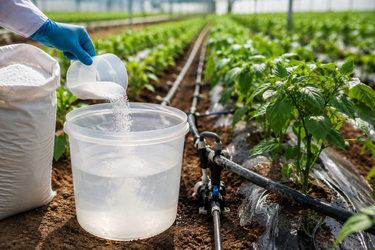
Best Water Soluble Fertilizer for Drip Irrigation
Introduction
The best water soluble fertilizer for drip irrigation is one that dissolves completely in water, delivers consistent nutrients, and works reliably with irrigation systems without clogging emitters. High-quality drip irrigation fertilizer should provide excellent water solubility, stable nutrient content, and compatibility with fertigation equipment to ensure efficient nutrient delivery throughout the growing season.
However, not every fertilizer is suitable for drip irrigation. Products with poor solubility or excessive insoluble residues can block irrigation lines, reduce nutrient availability, and increase maintenance costs. The right fertigation fertilizer depends on several factors, including crop type, growth stage, irrigation water quality, fertilization strategy, and operational requirements. Selecting the appropriate formulation helps improve nutrient use efficiency while supporting healthy crop growth.
This guide explains the key characteristics of an effective water-soluble fertilizer, compares common fertilizer options used in drip irrigation, and outlines suitable nutrient choices for different crop stages. Whether you are sourcing from a water soluble fertilizer supplier or purchasing bulk water soluble fertilizer for commercial agriculture, understanding these factors can help you make a more informed decision.
What Makes a Fertilizer Suitable for Drip Irrigation?
Drip irrigation systems require fertilizers that dissolve quickly and remain stable throughout the fertigation process. Selecting the right drip irrigation fertilizer helps maintain irrigation efficiency while ensuring crops receive nutrients evenly.
High Water Solubility
Complete water solubility is one of the most important requirements for any fertigation fertilizer. High-quality water-soluble fertilizers dissolve rapidly without leaving visible particles that may accumulate inside pipes, filters, or emitters.
Poorly dissolved fertilizers can increase maintenance requirements and reduce irrigation uniformity. For this reason, professional growers generally prefer fertilizers specifically manufactured for fertigation rather than conventional granular field fertilizers.
Low Insoluble Matter
Even highly soluble fertilizers may contain a small percentage of insoluble impurities. Lower insoluble content reduces the likelihood of sediment formation inside irrigation systems.
When purchasing bulk water soluble fertilizer, buyers often review product specifications for insoluble matter to ensure compatibility with modern drip irrigation equipment.
Stable Nutrient Content
Nutrient consistency is another critical factor. Reliable fertilizers provide stable concentrations of nitrogen, potassium, calcium, magnesium, and other nutrients in every batch.
Consistent nutrient composition allows growers to accurately calculate fertilizer application rates throughout different crop stages, helping maintain predictable crop performance.
Good Compatibility with Irrigation Water
Water quality varies significantly between regions. High hardness, elevated bicarbonate levels, or unsuitable pH may influence fertilizer performance.
A quality drip irrigation fertilizer should dissolve well under normal irrigation conditions while remaining compatible with commonly used irrigation water. In practice, growers should also conduct compatibility tests before mixing different fertilizers in the same solution.
For example, calcium-containing fertilizers should generally not be mixed directly with concentrated phosphate or sulfate fertilizers because insoluble precipitates may form.
Suitable Nutrient Ratio
Different crops require different nutrient balances throughout the season. The best water soluble fertilizer is not necessarily one universal product but rather the formulation that matches crop nutritional demand.
Balanced NPK fertilizers are commonly used during early growth, while higher potassium formulations are often selected during fruit development. Calcium and magnesium fertilizers may be incorporated when secondary nutrients become limiting.
Matching fertilizer formulation with crop demand improves nutrient efficiency while avoiding excessive fertilizer application.
Low Caking Risk
Storage stability also affects fertilizer quality. Products with good anti-caking performance remain free-flowing during transportation and storage, making them easier to dissolve and apply.
This characteristic is especially important for distributors and agricultural suppliers purchasing bulk water soluble fertilizer in large quantities.
Proper Packaging and Storage
Even premium fertilizers can lose quality if stored improperly. Moisture exposure may lead to caking, reduced flowability, or nutrient degradation.
Good packaging helps protect fertilizer during transportation and warehouse storage. Manufacturers commonly recommend storing products in cool, dry, and well-ventilated environments while keeping bags tightly sealed after opening.
Common Water-Soluble Fertilizer Options for Drip Irrigation
Several fertilizer types are widely used in modern fertigation systems. Each provides a different nutrient profile and supports specific crop requirements.
Potassium Nitrate
Potassium nitrate is one of the most widely used products in fertigation fertilizer programs because it supplies both nitrogen (N) and potassium (K) in highly available forms.
Nitrogen supports vegetative growth and overall plant development, while potassium plays an important role in water regulation, sugar transport, fruit enlargement, color development, and crop quality.
Because of its excellent water solubility, potassium nitrate is commonly used as a drip irrigation fertilizer for vegetables, fruits, berries, orchards, greenhouse crops, and high-value horticultural production.
Another advantage is its chloride-free composition, making it suitable for crops that are sensitive to chloride accumulation. Growers frequently include potassium nitrate in precision fertigation programs where accurate nutrient delivery is required.
Calcium Nitrate
Calcium nitrate supplies readily available nitrogen together with calcium, making it an important fertilizer for crops that require strong cell wall development and healthy root growth.
Adequate calcium nutrition helps reduce physiological disorders such as blossom-end rot in tomatoes and peppers or tip burn in leafy vegetables. Nitrogen in nitrate form is also immediately available for plant uptake.
Calcium nitrate is widely used in greenhouse production, protected agriculture, fruit crops, and commercial vegetable farming through drip irrigation systems.
However, compatibility should always be considered. Calcium nitrate should generally be stored or injected separately from concentrated phosphate- or sulfate-based fertilizers because precipitation may occur if incompatible products are mixed in high concentrations.
This fertilizer is often selected by growers looking for reliable fertigation fertilizer solutions that provide both nitrogen and calcium efficiently.
Magnesium Nitrate
Magnesium nitrate provides nitrogen together with magnesium, an essential element found at the center of every chlorophyll molecule.
Adequate magnesium supports photosynthesis, promotes healthy green leaves, and contributes to efficient energy production within plants. Crops with magnesium deficiency often develop leaf yellowing, reduced photosynthetic capacity, and slower growth.
Its high solubility allows uniform nutrient delivery through irrigation systems, making it suitable for greenhouse vegetables, fruit trees, and many field crops.
NPK Water-Soluble Fertilizer
NPK water-soluble fertilizers provide nitrogen (N), phosphorus (P), and potassium (K) in balanced or customized ratios, making them one of the most versatile options for modern fertigation fertilizer programs. Unlike single-nutrient products, NPK formulations can be tailored to meet crop requirements at different growth stages.
Balanced formulations, such as 20-20-20, are commonly used during early growth to support root establishment and overall plant development. As crops transition into flowering or fruiting, growers often switch to formulas with higher potassium or phosphorus content to better match changing nutrient demands.
Because these fertilizers dissolve quickly and distribute nutrients evenly through irrigation systems, they are widely used as drip irrigation fertilizer for vegetables, fruits, greenhouse crops, flowers, and commercial field production. Selecting the appropriate NPK ratio according to crop growth stage can help improve nutrient efficiency while supporting stable yields and crop quality.
Best Water-Soluble Fertilizer Options by Crop Stage
Crop nutrient requirements change as plants develop, so selecting the best water soluble fertilizer should be based on growth stage rather than using the same formulation from planting to harvest.
The table below summarizes common nutrient priorities and suitable fertilizer options for each stage.
| Crop Stage | Nutrient Focus | Suitable Options |
|---|---|---|
| Early Growth | Balanced nutrition and root development | Balanced NPK, Calcium Nitrate |
| Vegetative Growth | Nitrogen and magnesium supply | Magnesium Nitrate, Balanced NPK |
| Flowering | Balanced nutrition and calcium support | Calcium Nitrate, Potassium Nitrate |
| Fruit Expansion | Higher potassium and calcium demand | Potassium Nitrate, Calcium Nitrate, High-K NPK |
| Maturity / Quality Improvement | Potassium-focused nutrition | Potassium Nitrate, High-Potassium NPK |
Early Growth
During early establishment, crops require balanced nutrition to develop healthy roots and vigorous seedlings. At this stage, excessive potassium is generally unnecessary, while adequate nitrogen and phosphorus are essential for early growth.
Balanced NPK formulations are commonly selected as the primary fertigation fertilizer, while calcium nitrate may be introduced to provide readily available nitrogen and calcium for root and cell development.
Vegetative Growth
As plants enter rapid vegetative growth, nutrient demand increases significantly. Nitrogen supports leaf expansion and stem growth, while magnesium plays a key role in chlorophyll formation and photosynthesis.
Magnesium nitrate is often used to maintain healthy foliage, especially in leafy vegetables and greenhouse crops. Balanced NPK fertilizers may also continue to provide a complete nutrient supply where required.
Flowering
Flower initiation marks an important transition in crop development. Stable nutrition becomes increasingly important to support flower formation and improve fruit set.
Calcium nitrate helps maintain strong cell structure and supports reproductive growth, while potassium nitrate provides additional potassium to prepare crops for the next stage. Many growers combine these products through carefully planned fertigation schedules, ensuring compatibility during application.
Fruit Expansion
Fruit enlargement is typically the period of highest potassium demand. Potassium supports carbohydrate transport, fruit size, color development, and overall crop quality, while calcium contributes to firmness and storage performance.
For many fruiting vegetables and orchard crops, potassium nitrate becomes one of the preferred drip irrigation fertilizer options during this stage. High-potassium NPK formulations may also be incorporated depending on crop requirements and fertilization programs.
Maturity and Quality Improvement
As harvest approaches, nutrient management often shifts toward improving product quality rather than promoting additional vegetative growth.
High-potassium fertilizers are commonly used to enhance fruit color, sweetness, firmness, and marketability. Potassium nitrate and high-potassium NPK formulations remain popular choices because they deliver potassium efficiently through drip irrigation systems while maintaining good water solubility.
Proper nutrient management during the final growth stage can also contribute to more uniform crop development and improved post-harvest quality.
Knlan Water-Soluble Fertilizers for Drip Irrigation and Fertigation
Knlan supplies a range of water-soluble fertilizers designed for modern agricultural applications. The product portfolio covers several commonly used nutrient sources for drip irrigation and fertigation, allowing buyers to select formulations based on crop requirements and local fertilization programs.
Potassium Nitrate for Fruit and Vegetable Production
Knlan's potassium nitrate provides highly soluble nitrogen and potassium for crops with increased potassium demand. It is widely used during flowering, fruit expansion, and quality improvement stages, where efficient potassium delivery supports fruit size, color, and overall crop performance. Its excellent water solubility makes it suitable for drip irrigation fertilizer systems, helping nutrients move evenly through irrigation lines while reducing the risk of residue accumulation.
Calcium Nitrate for Calcium Management
Calcium nitrate supplies nitrate nitrogen together with readily available calcium, making it suitable for crops that require additional calcium throughout the growing cycle.
As with all calcium-based fertilizers, compatibility with phosphate- and sulfate-containing products should be considered during fertilizer preparation.
Magnesium Nitrate for Healthy Vegetative Growth
Magnesium nitrate provides an effective source of both nitrogen and magnesium, supporting chlorophyll production and healthy leaf development.
It can be incorporated into drip irrigation and foliar feeding programs when magnesium supplementation is required, particularly during periods of rapid vegetative growth or where magnesium deficiency is likely to occur.
NPK Solutions for Different Crop Stages
Knlan also offers NPK water-soluble fertilizers in various nutrient ratios to meet different crop and growth-stage requirements.
Balanced formulations are suitable for general crop nutrition, while customized nutrient ratios can support specific production goals such as flowering, fruit development, or quality improvement. These fertilizers dissolve readily in water and are compatible with properly managed fertigation systems.
Suitable for Multiple Agricultural Applications
In addition to drip irrigation, Knlan's products are suitable for a variety of crop nutrition methods, including:
- Drip irrigation
- Fertigation systems
- Foliar feeding
- Greenhouse cultivation
- Open-field agriculture
- Integrated crop nutrition programs
This flexibility allows distributors, agricultural suppliers, and commercial farms to build fertilization programs that match different crops, climates, and production practices.
For buyers looking for bulk water soluble fertilizer, Knlan provides multiple packaging options to accommodate different supply requirements. Product specifications, packaging details, and minimum order quantities can be discussed according to individual purchasing needs.
Conclusion
The best water soluble fertilizer for drip irrigation is the one that combines high water solubility, consistent nutrient quality, low insoluble content, and compatibility with your irrigation system. Because nutrient requirements vary by crop and growth stage, growers often achieve the best results by selecting different fertilizer formulations throughout the season rather than relying on a single product.
Whether you need potassium nitrate, calcium nitrate, magnesium nitrate, or customized NPK formulations, partnering with an experienced water soluble fertilizer supplier can help ensure reliable product quality and a stable supply. Knlan offers a comprehensive range of water-soluble fertilizers for drip irrigation, fertigation, and crop nutrition programs. If you are sourcing bulk water soluble fertilizer, you can contact the Knlan team for detailed specifications, packaging options, minimum order quantities, and pricing.

Blending chemical innovation with sustainable practices to produce premium nitrates that power crops and industries across continents.
Be the first to know about new collections and exclusive offers.
@2025 Shanxi Knlan Chemical Co., Ltd